Cote d'Ivoire (La Côte d'Ivoire)
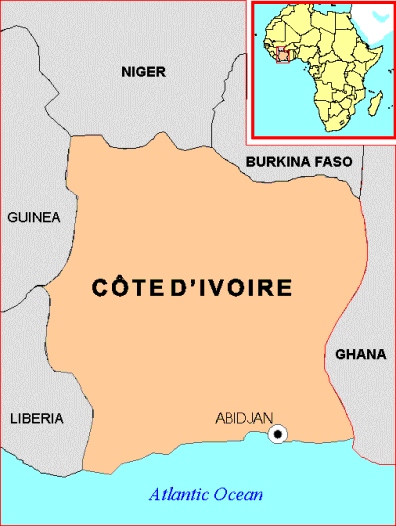
Description: Map of Cote d'Ivoire
Image copyright: http://www.uneca.org/aisi/nici/country_profiles/image/Cote%20d'Ivoire.jpg
•It is on the continent of Africa, the region of Western Africa, and it borders Liberia on the West, Ghana on the East, and the North Atlantic Ocean on the South
•In area, it is slightly larger than New Mexico
•Its climate is tropical along its coast, semiarid in the North, and its 3 seasons are: warm and dry (November to March), hot and dry (March to May), and hot and wet (June to October)
•18 million people live there, more would if it were not for AIDS
•7% of the population has HIV/AIDS
•Most of its inhabitants live on the coast, and the interior is sparsely populated
•The population growth rate is 2%
•Its capital is Yamoussoukro
•Abidjan, Bouake, Daloa, Korgho are the other main cities
•Ethnic groups are: Akan 42.1%, Voltaiques or Gur 17.6%, Northern Mandes 16.5%, Krous 11%, Southern Mandes 10%, other 2.8% (includes 130,000 Lebanese and 14,000 French)
•Religions are: Muslim 35-40%, indigenous 25-40%, Christians 20-30%
•Languages are: French is the official language, 60 native dialects with Dioula the most commonly spoken
•Economy: Cote d’Ivoire is among the world’s largest exporters of coffee, cocoa, beans, and palm oil. Its economy has been hurt by the recent civil war. In the future it plans on increasing crude oil exports from 58,000 to 200,000 barrels a day
•Cote d’Ivoire is really poor with the average GDP per capita of $1,800 and 37% of the population is below the poverty level
•60% of the labor force is employed in agriculture or forestry
•Principal main agriculture cash crops are cacao, cotton, and coffee
•46% of the population is urban while 54% is rural
•More urban dwellers are unemployed than rural dwellers
•The countries traditional music style is characterized by a series of melodies and rhythms occurring simultaneously without one dominating the others
•Alpha Blondy is a world famous reggae artist from Cote d’Ivoire but his music isn’t representative
•The Baoule, The Dan, and The Senoufo are all known for their wood carvings
•The Ivory Coast produces the largest variety of masks in the world
•Masks are used to represent the souls of deceased people, lesser deities, or even caricatures of animals
•Traditional food is similar to neighboring nations with reliance on grains and tubers
•Attiéké (grated cassava) is a popular side dish there
•Maquis are open air restaurants unique to Cote d’Ivoire
•They normally feature braised chicken and fish smothered in onions and tomatoes, served with attiéké, or kedjenou, a chicken dish made with vegetables and a mild sauce
•One of the tastiest street-vended foods is aloco, which is ripe banana in palm oil, spiced with steamed onions and chili and eaten alone or with grilled fish
•Bangui is a local palm wine
