by Mary Jude Schmitz
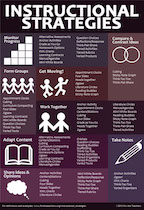
Description: Instructional Strategies
Image copyright: http://www.teachthought.com/pedagogy/instructional-strategies/50-teaching-strategies-to-jumpstart-your-teacher-brain/
In one type of experiential learning, teachers can use games in order to make learning material more fun and to motivate students to want to answer questions or solve problems. Games are best used after material has been introduced so that students can put into practice what they have learned. For example, in my classes, I can use Quizlet to create a group of flash cards consisting of vocabulary mixed with math problems and other topics and then use a game called Quizlet Live to have students work in groups in competition with each other. Another game I can use are CSI games where students must solve problems in order to catch the criminal.
2. Learning Centered Teaching – problem solving
Problem solving strategies include teaching the steps for solving problems and then giving students the opportunity to use those steps to solve different types of problems. Reflective problem solving includes:
• Define the problem
• Analyze the problem
• Establish Criteria
• Propose Solutions
• Take Action
I can use problem solving strategies with my geometry students when we work on proofs. In order to write proofs, students must decide what information they have to start with, where they need to finish, and then must propose solutions on how to get there. The problem solving skills the students learn through writing proofs can then translate to other problems they need to solve, either in mathematics, other classes, or even outside school.
3. Experiential Learning - project-based learning
Project based learning is another strategy that requires students to take knowledge and skills that they have learned and put them to use. In this strategy, students take prior knowledge and skills and solve a problem presented by the teacher. To truly be project based learning, students must also reflect on how they used their knowledge and skills to solve the problem. One example of how I can use this in my classroom is having students calculate the heights of things around school using right triangles and trigonometry. Students would use their knowledge of how to use right triangles to solve for a length that cannot be easily measured. In this way, my students would be putting their right triangle and trigonometry skills to practice to answer real questions and solve real problems.
4. Learning Centered Teaching – concept maps
Concept maps are a way for students to organize knowledge to better understand it. Sometimes teaching involves understanding concepts and words rather than problem solving and this is a good strategy to let students personalize that knowledge. Rather than just writing down information, students can visually organize it so that they can better remember and understand the information. An example of this in my classroom would be having students create a graphic organizer to represent classifying triangles by sides and angles. Rather than just having them list the classifications, I can have them build a concept map of the classifications. This is a great strategy to help students visually understand that an equilateral triangle is a type of isosceles and that they are not two completely different categories. Another idea is to have students make venn diagrams of quadrilaterals. This helps them to understand things like a square is always a rectangle, but a rectangle is not always a square.
5. Interactive Instruction – cooperative learning
Cooperative learning is a strategy that requires students to work together in groups to complete a task. This is an extremely useful strategy because it not only teaches the content involved in the task, but also teaches students to work together in groups, a skill they will need outside the classroom. When students have to work together, each person is able to contribute to completing the task using his or her own strengths and therefore this strategy takes into account the diversity of the learners. Also, this strategy also requires students to teach each other giving an extra resource to the one receiving the help and solidifying the learning for the one who is giving the help. I can use this strategy in my classes by assigning groups where students work together to solve math problems, play games involving the content, or do projects.
6. Direct Instruction – explicit teaching
Explicit teaching involves directly teaching a concept to students instead of having them work it out on their own. While this is not a teaching strategy that should be used all the time, it definitely has its place. Through explicit teaching, teachers can show students how to solve problems through modeling, can introduce new ideas and vocabulary. To put a twist on the old idea of explicit teaching, I use this strategy in my flipped classroom and do the direct instruction through video. Since reaching individuals is a big part of explicit teaching, I think this is the best medium for it since each student watches the video and listens to me talking and it is like I am talking only to them. Plus, if a student misses something, she can rewind and watch again.
7. Interactive Instruction – think, pair, share
In this strategy, students pair up in teams of 4 (so 1 and 2 are a pair and 3 and 4 are a pair) and the teacher poses a question. The students have 10 seconds to think of their own answer, then they are to discuss solutions with their partner. After a sufficient amount of time for discussion, the teacher will call on random pairs to share their ideas. The purpose of this strategy is to get students to think more deeply about the questions presented before giving answers and to get all students involved in discussing the ideas or solutions instead of just a few. I would love to pose overarching questions in my classes before class started to get my students thinking about the purpose of the material they were going to learn that day. This would be a great strategy for that. Like Dan Meyer says, students need a reason for why they are learning what they are learning and this activity would help get their brain gears moving and get them motivated.
