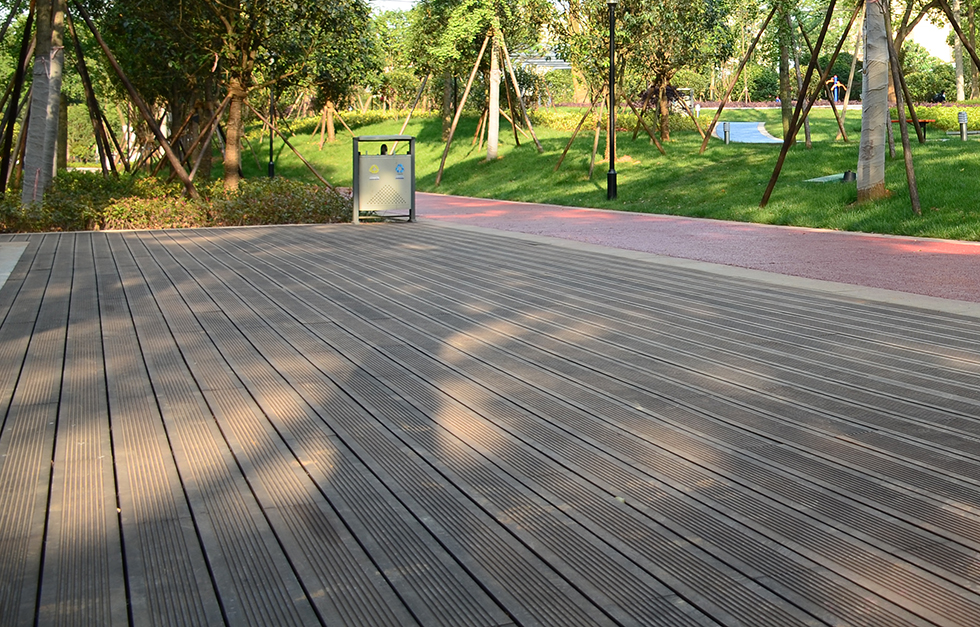
bamboo decking
|
|
The idea of a zero-deforestation deck is straightforward: an outdoor surface that looks beautiful and lasts for years without driving the loss of forest cover. For a long time, that goal forced a compromise. Materials with the strongest environmental story often lacked the strength to survive a real climate, while the toughest options carried a heavy ecological cost. EcoSmart solutions have changed that calculation, and thermally modified strand woven exterior bamboo decking is at the center of the shift. It comes from a plant that regrows on a short cycle, can be engineered into a remarkably hard board, and fits naturally into a modern outdoor design. This article looks at what the zero-deforestation claim actually means and why bamboo delivers on it. What a Zero-Deforestation Deck Really MeansThe phrase is easy to use loosely, so it deserves a careful definition. A deck cannot be literally detached from the land; it is made of something that grew somewhere. What the term should mean is that the raw material does not come from clearing established forest, that the source is managed so it keeps regenerating, and that the supply can be traced. That distinction matters because deforestation is about what replaces the forest, not simply about whether a material is natural. A board cut from a slow-growing tree in a cleared woodland and a board pressed from a fast-renewing grass are both natural products, but their stories are very different. A genuinely EcoSmart approach also looks beyond the source. It asks how long the deck will last, because a surface that needs replacing every few years consumes far more material over its lifetime than one that stays in place for decades. It considers the finish and the adhesive, the waste created during installation, and the way the board is fixed. Zero deforestation is the starting point rather than the finish line, and the best outdoor upgrades treat it as one part of a wider decision. Why Bamboo Is the Logical CenterpieceBamboo makes the environmental argument unusually easy to explain. It is a grass, not a tree, and it grows back after harvest from the same root system without the land being cleared. Published figures from a long-established bamboo producer put harvest maturity at four to six years, compared with roughly twenty-five years for hardwood. The same source notes that bamboo can grow as much as twenty-four inches in a single day under favorable conditions. Those numbers are not abstract. They describe a raw material that can be renewed on a human timescale rather than a forestry timescale, which is precisely what a zero-deforestation deck needs. Renewal alone would not be enough. A deck must handle rain, sun, temperature swings, and constant foot traffic, and an ordinary grass would fail quickly outdoors. The answer lies in how the material is processed. Strand-woven bamboo is made by separating the fibers, treating them, and compressing them under high pressure with a resin binder into a dense, solid board. The result is a hard, stable product that behaves far more like a premium hardwood than like the plant it came from. That combination of fast renewal and genuine strength is what puts bamboo at the center of an EcoSmart outdoor space. Performance That Matches the EthicAn environmental choice that fails in use is no environmental victory, because it ends up in a landfill and gets replaced. This is where the engineering behind bamboo decking earns its keep. The dense, compressed structure resists denting and wear from shoes, furniture, and pets. Quality exterior boards are treated to manage moisture, mold, and insects, and many carry fire and structural ratings that suit them to real building requirements. Dimensional stability is equally important: a board that stays flat through wet and dry seasons is a board that does not warp, cup, or pull away from its fixings. Longevity is the quiet environmental metric. A deck that serves for decades with only occasional care consumes fewer resources than one that is cheap to buy and quick to fail. When the raw material also regrows within a few years, the lifecycle picture becomes compelling. This is the reason bamboo keeps appearing in low-impact projects: it does not ask the homeowner to trade performance for principle. The upgrade looks and feels like a conventional premium deck while resting on a very different foundation. EcoSmart Choices Beyond the BoardsThe boards are the largest decision, but not the only one. A considered upgrade looks at everything that goes into the finished space. Water-based or low-emission finishes reduce the amount of harsh treatment brought into a garden, and reputable manufacturers are increasingly willing to describe their coatings and adhesives. Hidden clip systems avoid rows of screws that catch clothing and collect water, while allowing the deck to move as the boards expand and contract. Water management deserves special attention. A deck that sheds rain cleanly lasts longer and needs less cleaning than one where moisture sits in the joints. That means sensible joist spacing, a slight fall away from the house, and clear drainage around the perimeter. Irrigation should be aimed away from the surface, and planters raised so air can circulate underneath. These inexpensive decisions determine how much care the deck will need. EcoSmart design is often just careful design applied consistently. Reading the Certifications CorrectlyGreen claims are easy to make and difficult to verify, so documentation is what separates substance from slogans. When sourcing bamboo decking, ask about certification and traceability. Forest Stewardship Council certification, commonly known as FSC, is a recognized signal that material comes from responsibly managed sources. CE marking and standardized test results provide a checkable basis for performance and safety claims. A supplier that can produce this paperwork, explain the treatment process, and share technical data is operating in a different league from one that relies only on broad environmental language. Be cautious of any claim that sounds absolute without evidence. Ask where the bamboo is grown, how it is treated, and what the warranty covers. Request samples so the color and texture can be judged in the actual light of the site; photographs rarely capture the fine grain of a strand-woven board. Transparency is not a small courtesy in sustainable building. It is the mechanism that lets a buyer confirm the zero-deforestation story rather than simply hope it is true. Designing the UpgradeAn outdoor upgrade should improve how a space is used, not just how it photographs. Bamboo decking suits contemporary gardens because its fine linear grain reads as both natural and architectural. It works as a clean platform under a pergola, a level surface on a sloping site, or a warm transition between interior and garden. When the board tone echoes the timber or stone used elsewhere in the home, the deck becomes part of a single composition rather than an added structure. The layout also shapes daily life. A generous boardwalk encourages movement through the garden, while a broad level area makes seating and dining practical. Thoughtful edge lighting extends the hours the space can be enjoyed, and a careful transition at the door keeps moisture from tracking indoors. Making the existing garden more usable is a quiet but real gain, because it supports time spent at home rather than travel elsewhere. The best upgrade is one that people actually use. |