| Henry VIII Trial |
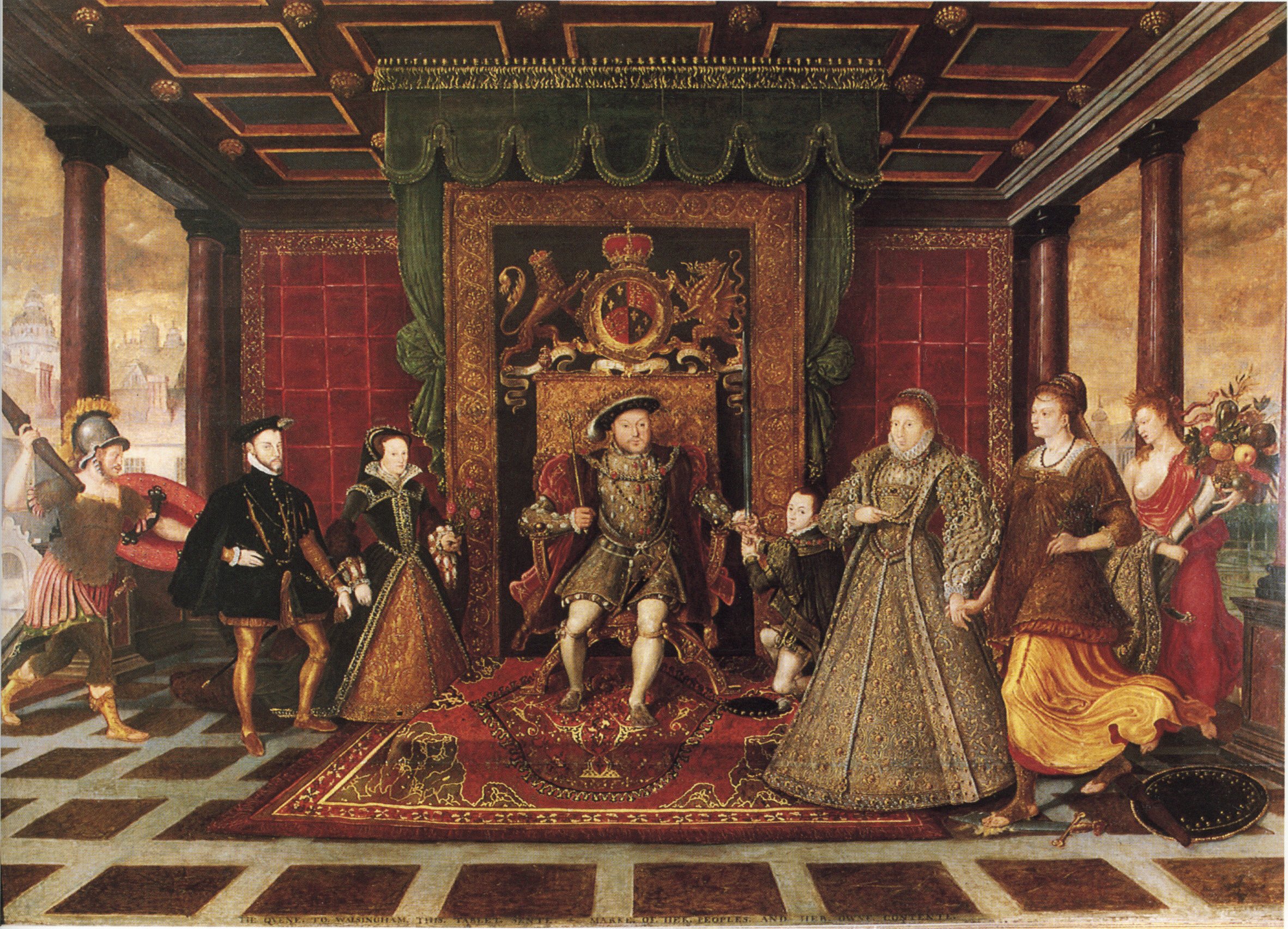
Unknown. "The Allegory of the Tudor Succession." Yale British Museum, New Haven.
|
Unknown. "The Allegory of the Tudor Succession." Yale British Museum, New Haven. |
|
Henry VIII Trial Examining the Reformation Brian Kirby OBJECTIVE: Explore the manner in which the Reformation reshapes Europe politically, economically and socially. In order to reach this objective, we will place Henry VIII on trial for heresy, to be prosecuted by Thomas More and defended by Archbishop Cranmer. Witnesses shall be called from a variety of time periods, both preceding and following the actual historical events, in order to illustrate the cause and effect of this movement both on the development of England, and Europe as a whole. Students should be able to demonstrate: 1. An awareness of the roles played by the assigned individual prior to, during and after the reformation. Testimony will directly address situations; 1) prior to the reformation, and the positive or negative role of the RCC, 2) during the reformation and potential justifications for actions taken by Henry VIII and the potential future benefits or the negative consequences of, and 3) an evaluation in hindsight either supporting or refuting the decision of Henry. 2. An understanding of cause and effect, both within England and the broader European picture. 3. An ability to respond within a historically defendable interpretation of how his/her character may have responded if testifying in such a situation. PROCEDURE: Call to order. Presentation of the charges against Henry VIII and an introduction of the prosecution and defense counsel. Day 1 - Prosecution. Defense will be allowed to ask 1 question or present a 30 second refute of each witness. (There is a strong likelihood of asking a question about which the "witness" would be unable to answer, thus undermining your cross). Day 2 - Presentation of defense case. Prosecution may cross defense witnesses, and the defense may recall prosecution witnesses, time permitting. Day 3 - Closing arguments (5 minutes each) Things to Remember: ALL STUDENTS MUST PARTICIPATE! All witnesses should be properly prepped, and both the prosecutor and defense should draw up questions for the witnesses, as well as potential cross exam questions. KEEP THE QUESTIONS RELEVANT! DONT ask a question unless you already know the answer. Each team member is an assistant prosecutor or defense counsel. As such, divide and conquer! Not only should you try to become as knowledgeable about your assigned character as possible, but you should do so for 1-2 of the opponents as well. The lead prosecutor and defense counsel are not responsible for all of the work! I will work with each lead counsel in class on the first day to review broad themes/questions to be addressed. EVALUATION: This is not much different than drafting a solid essay. I will look for a strong defendable position along with general supporting arguments in the opening statements. The specific evidence (or body) will be presented through the witnesses and questioning. You will receive three scores as follows: 1. Team (50pts.). Based on the same criteria/rubric as an essay. This will evaluate your opening statements and supporting evidence. It is the responsibility of the team leader to manage the time and ensure that all team members participate. Teams will lose a full letter grade for each non-participation. 2. Individual(50 pts.). This grade will evaluate each students understanding and ability to portray a historically accurate character. A Exceptional: Is able to give not only a factually accurate account of the assigned individual, but also demonstrates a strong understanding of the character through convincing historical interpretation. This will be particularly evident during the cross examination when fielding unprepared questions. B - Good: Is able to give a factually accurate account of the assigned individual, and demonstrates an understanding of the character through convincing historical interpretation. C - Average: Is able to give a factually accurate account of the assigned individual, but may struggle to demonstrate a strong understanding of the character within the context of this trial. This will be particularly evident during the cross examination when fielding unprepared questions. D - Poor: Contains factual errors or is unable to demonstrate an understanding of the assigned individual within the context of this trial. CLOSURE: One page written evaluation of the trial. Address the following: What key element(s) was each side successful in arguing? What did your side do well? What were your weaknesses? CHARGES: 1 - Heresy 2 - Leading the people of Britain to eternal damnation 3 - Undermining the political, economic and social fabric of Europe. List of Characters: For the prosecution: Thomas More (Prosecutor) Charles V Cardinal Wolsey Erasmus Catherine of Aragon Phillip II Mary Tudor Mary, Queen of Scotts Ignacius Loyola Popes - Pius II (1458-64) Paul II (1464-71) Sixtus IV (1471-84) Innocent VIII (1484-92) Alexander VI (1492-1503) Pius III (1503) Julius II (1503-13) Leo X (1513-21) Adrian VI (1522-23) Clement VII (1523-34) Paul III (1534-49) Julius III (1550-55) Marcellus II (1555) Paul IV (1555-59) Pius IV (1559-65) St. Pius V (1566-72) Gregory XIII (1572-85) Sixtus V (1585-90) Urban VII (1590) Gregory XIV (1590-91) Innocent IX (1591) Clement VIII (1592-1605) For the Defense: Henry VIII (D) Protestant Nobleman (Everyman) (D) William of Orange (D) Queen Elizabeth (D) Galileo (D) Sir Isaac Newton (D) Martin Luther (D) John Calvin (D) Thomas Cromwell (D) Archbishop Cranmer (D) (Lead Defense) Oliver Cromwell (D) Frances I Jean Wycliffe |