|
Teaching and Communication Strategies Capitalizing on Students' Strengths
|
|
|
|
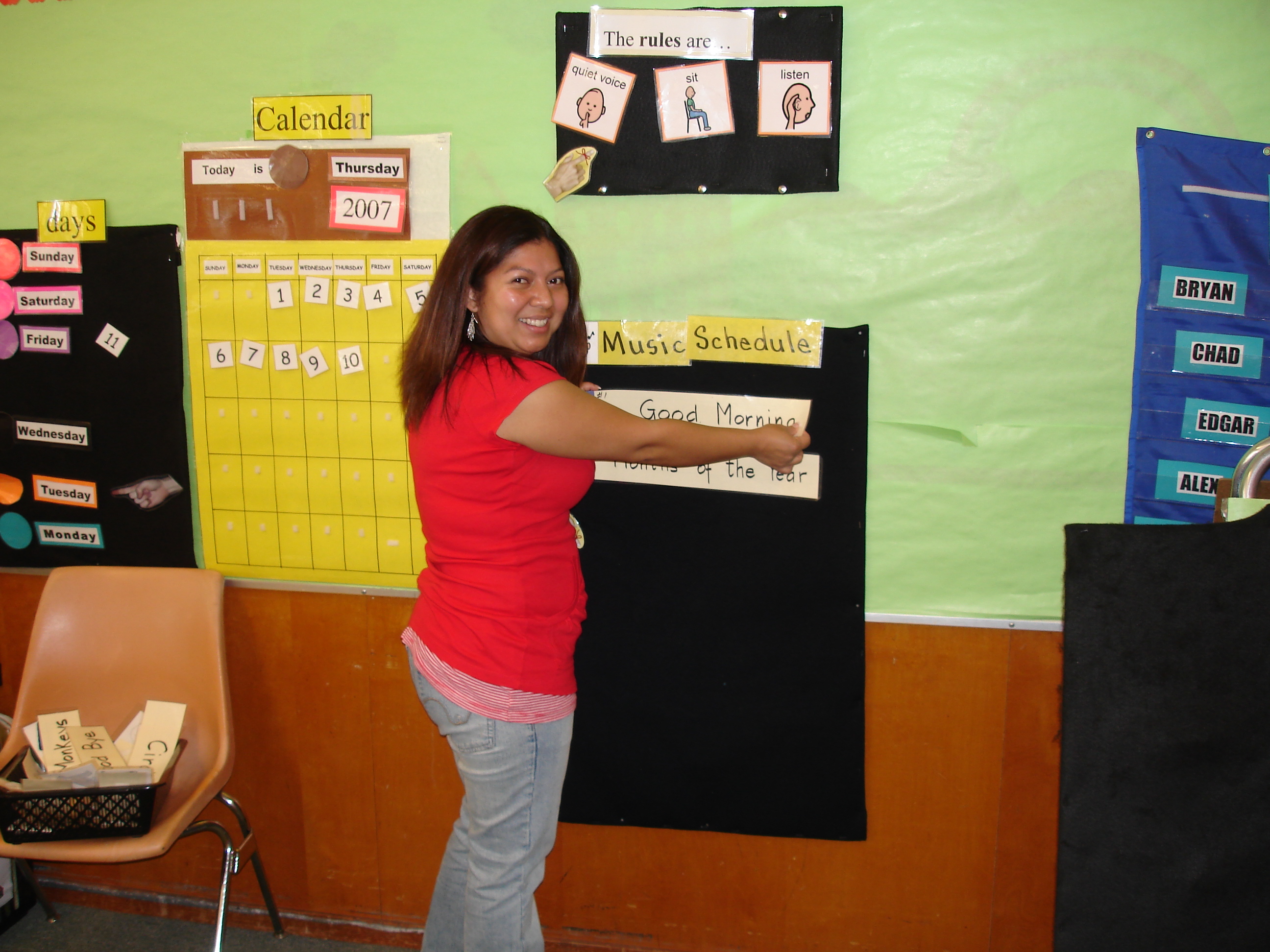
ONE SIZE DOES NOT FIT ALL. There is no one, single teaching approach that will work with ALL students with autism, which is why it is very important to be creative and flexible. In the article titled "Autistic Learning Disabilities and Individualizing Treatment for Autistic Spectrum Disorders," Dr. Bryna Siegel seems to suggest the importance of expanding our notions of the autistic spectrum disorder from merely a medical diagnosis to a learning disability (see Infants and Young Children, 1999. 12(2): 27-36). The terminology she uses is Autistic Learning Disabilities or ALD, which describes speicifc key area deficits in a person with autism. Siegel breaks ALD into three main components, in line with the DSM-IV criteria for PDD or ASD, and expands each main group into specific characteristics that may be observed in a person with autism. Needless to say, autistic chidren will demonstrate these characterisitcs in varying degrees. And so, the ALD list sort of creates a small inventory of deficits, each of which can then be addressed as needed when selecting a treatment program or selecting educational goals. The ALD description is as follows below. (Please note that this chart was taken from the journal article cited directly above.) "Taxonomy of Autistic Learning Disabilities" Social Interaction Based Disabilities • Lack of social reference • Lack of response to social reward • Lack of modeling/imitation • Lack of drive for peer affiliation Communication Based Disabilities • Problems in comprehension of natural gesture and emotional expression • Problems in expression of natural gestural and facial expression • Preference for visual over auditory modalities • Problems of gestalt perception and processing Disabilities Based in Processing Environmental Stimuli • Stimulus over-selectivity/perseveration on parts of objects • Low response to novelty/preference for routines and ritual patterns of action • Sensory modulation difficulties PUTTING IT ALL INTO ACTION. As a teacher of autistic students, one of the teaching methodologies that I relied on was the "TEACCH Model" (TEACCH is short for the "Teaching and Education of Autistic and related Communicative Handicapped Children"), a program developed at the University of North Carolina in the 1970's to address the growing need for an effective way of education students with autism. TEACCH, in my opinion, can best be viewed as an "approach" rather than a restrictive perscription. The approach is based on the idea that sets up a classroom or program around the strengths of an autistic student. For example, TEACCH capitalizes on an autistic student's preference for visual learning and routine, and so a TEACCH-based classroom would normally have a highly structured classroom environment where many tasks proceed in a sequential manner. There is sort of a regular, consistent and orderly work flow that the special educator may try to establish. Case in point: Many TEACCH-based classrooms set up a specific task-by-task individual and group schedule board. Often these schedules are depicted by visual based icons (e.g. an icon for "work", "math", "reading", etc.) and are usually mounted by the student's work station where the student can easily access and refer to it. One of its goals is to adapt the learning environment so that the student can attain a greater degree of functional independence. The TEACCH approach sets up the learning environment so that it makes sens for the autistic person as much as possible. Below is a list of some of the learning tools that are in typically used in a TEACCH-based classroom: • ICONS. Icons are two-dimentional visual representations of specific items, objects, activities, food, toy, and various words that can be used as a communication tool by a pre-verbal or non-verbal child. (Icons are like picture cards.) These can be generated through the use of software programs such as Mayer-Johnson's BoardMaker, or one can make real picture icons using a digital camera. Deciding on whether to use Mayer-Johnson icons or real picture icons depends on each student. You have to observe how the student responds to each icon. In some cases, a Mayer-Johnson icon may be too abstract and the object or word it is depicting may not correspond to how the student visualizes that object in his mind. In this case, you may need to try real picture icons. (Note: Icons are usually laminated so that they last longer and normally have a velcro on the back so that they can be mounted in specific areas around the classroom.) • PICTURE EXCHANGE COMMUNICATION SYSTEM. This may be helpful for the pre-verbal autistic child or a child who is non-verbal. PECS is system where a child expresses his wants and needs by "exchanging" an icon for an object or request that corresponds to what the child is asking for. For example, if a student wanted to go to the bathroom, the student would hand a classroom staff member an icon for "bathroom." Typically, a TEACCH classroom will have what's called "choice boards" around the classroom where the student can access these icons. At other times, students will have his own folder or binder that has all the icons that he typically uses in the classroom. • INDIVIDUAL WORK STATIONS. Set up an individual work station so that it minimizes distraction and eliminates clutter. You could use partitions or cubicles to create a quiet, learning space for the student. Also, set up tasks so that the student has a clear expectation of what he is to accompish. For example, you could use a number or color coded filing system where the student can file away a worksheet or task that he has finished. In the past, I've placed a small bookshelf by each workstation and would place a task on each shelf. Once the student finished each task, he would place the finished work in an "ALL DONE" box, folder, or drawer. • SCHEDULE. Using icons appropriate for each child, set up a visual schedule that the child has to follow throughout the day. Many autistic students find it difficult to adjust to change and tends to stick to what's familiar to them. Create an environment with structure where the student knows what to expect. This kind of environment, once the student learns his ways around it, will minimize unnecessary anxiety for that student. LASTLY, A NOTE ON LANGUAGE. Keep it CONCRETE and SPECIFIC. Remember that autistic children have issues with auditory processing and tend to interpret things literally. If you tell him a joke like "a priest and a rabbi walk into a bar", he may more than likely visualize a priest and a rabbi literally walking into a long, metal rod. Keep it POSITIVE. Rather than saying "do NOT run", simply say "walk". Instead of saying "NO shouting", say "quiet voice". And the list goes on. Avoid RAPID-FIRE TALK. Many autistic person may get overstimulated or go into "sensory overload" in loud settings. Especially for an autistic child just starting to learn language, be sure to give an appropriate time for the child to process auditory information. Remember you want to encourage the student to learn to focus his attention to you (or anybody else) when you are speaking to him. You do not want him to shut down or have a melt down. |
 |
Links: |