|
Research Brief Summaries of Journal Articles
|
|
|
|
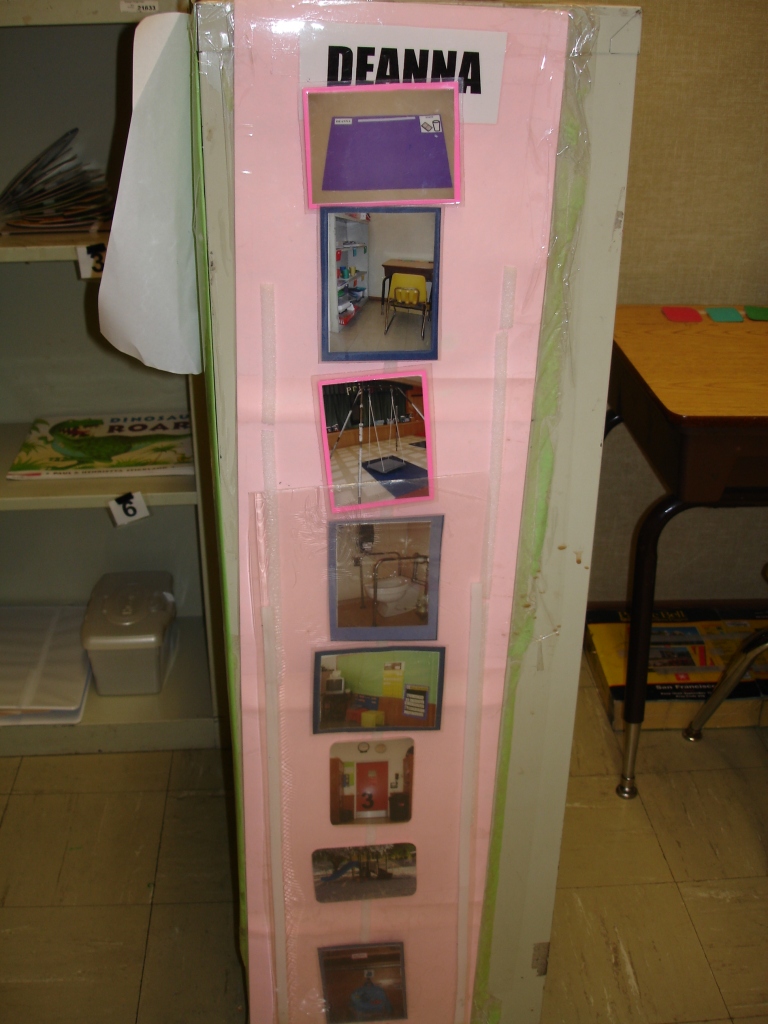
ARTICLE 1. "LEARNING THROUGH SEEING" Rao, Shaila; Gagie, Brenda. "Learning Through Seeing and Doing: Visual Supports for Children with Autism." Teaching Exceptional Children, v. 38, no. 36 (July/August), pp. 26-33. The article discusses different visual supports that can be used when working with an autistic child. I thought it was very practical and was pretty much consistent with some of the current practices recommended when working with an autistic child. For the most part, the article relies on the assumption that people with autism are strong visual learners. Other practical things that the article talks about includ things like using a visual schedule (e.g. the use of pictures,icons, graphic organizers, or a written schedule, depending on the student's abilities and needs). Another tip that the article talks about (and I've used this when I worked in the classroom) is setting up the tasks so that the student knows what to expect and knows when a particular task is finished. For example, as a teacher you can set up a workstation so that each student's assigned task is located in a particular folder, shelf, etc. Once that student is done with a task, the student can put the folder away or place it in an "All Done" filing box or shelf. Many students with autism have an especially difficult struggle with adjusting to new and unexpected situations. So, it is important to set up a work system that maintains a certain level of predictability for them (notice that this doesn't mean not having to change the content of what you're teaching them). ARTICLE 2. INDIVIDUALIZING TREATMENT FOR AUTISTIC SPECTRUM DISORDERS Siegel, Bryna. "Autistic Learning Disabilities and Individualizing Treatment for Autistic Spectrum Disorders." Infants and Young Children, 12(2) (October 1999), pp. 27-36. This is a very helpful article as far as choosing the appropriate treatment approaches for a child with autism. As I've discussed previously, Siegel broadens our conception of ASD from a medical diagnosis to a teaching or treatment approach and provides us a way of looking at the disorder as a learning disability, specifically as an Autistic Learning Disability or ALD. In this article, Siegel breaks in detail the different components of ALD, as consistent with the DSM-IV criteria for PDD, and gives a good starting point as to how to choose a program or educational goal that specifically targets those components of the disability. ARTICLE 3. REVIEW OF EFFECTIVENESS OF ABA Sheinkopf, Stephen J. and Bryna Siegel. "Home-Based Behavioral Treatment of Young Children with Autism." Journal of Autism & Developmental Disorders, v. 28, issue 1 (February 1998), pp. 15-23. In this article, Siegel reviews research done in the past on the effectiveness of home-based treatments developed by Ivar Lovaas. In the past, Lovaas has conducted experiments showing that intensive one-to-one behavior therapy can significantly affect an autistic chid's congnitive abilities. Siegel investigates some of these findings by doing a similar experiment using 11 autistic children, who received 27 hours or more intensive home-based therapy. The study was done along with a control group of 11 other autistic students receiving significantly less home-based one-to-one ABA. The treatmet was applied for approximately 16 months. The final result is that the group that received the increased hours of ABA did improve their IQ scores about 25 points higher than the control group. ARTICLE 4. TEACHING EMOTION RECOGNITION TO ASPERGER'S STUDENTS Lacava, P. G., et. al.. Using Assistive Technology to Teach Emotion Recognition to Students With Asperger Syndrome: A Pilot Study. Remedial and Special Education v. 28 no. 3 (May/June 2007) p. 174-81. This article uses a computer software program to help teach high-functioning students with Asperger Syndrome how to read emotional responses in other people. For example, the software teaches the students to recognize a few emotional responses such as "angry", "sad", "happy", etc. One down-side to this study is that it uses a very small sample size. The trials were conducted from 11 children with Asperger's. WHERE TO FIND IT? To search for these articles, please click on the "EBSCO Research Database" link on the right side of the page and use the following login information: Username: ndnu-library Password: NAMUR |
 |
Links: |