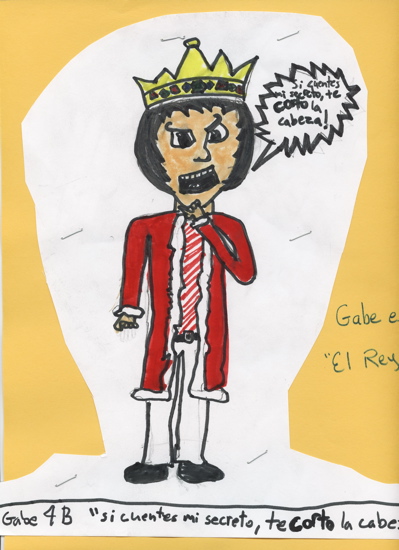
NARRADOR : Once upon a time, in a palace in the province of Castilla, there lived a Spanish king. He was a very good king - strong, inteligent, kind, and brave.
REY: Buenos días, yo soy el Rey. Vivo en el palacio. Soy muy bueno, fuerte, inteligente, simpático y valiente.
NARRADOR : The King had a secret - a very big secret.
REY: Tengo un secreto - un secreto muy grande.
NARRADOR : His secret was that he had only one ear. In Spanish, the word for someone with only one ear is “mocho”.
REY: (suspiciously) ¿Cómo? ¿Qué?
NARRADOR : No. . . nada. . .The king wore a large black wig. That way nobody knew his secret. The only one who knew the secret was the king’s barber, Manolo.
Manolo: Hola, Yo soy Manolo, el barbero del Rey. Yo sé el secreto del Rey. (singing)
El Rey es mocho,
No tiene oreja.
Por eso usa,
Una peluca vieja.
REY: (grabs the wig ) ¡No cuentes mi secreto!
Manolo: No, su majestad.
REY: Si cuentas mi secreto, te corto la cabeza.
Manolo: Sí, su majestad.
NARRADOR : But the barber was very old and one day he decided to retire.
Manolo: Estoy muy viejo. Voy a vivir en Fort Lauderdale. Adiós su majestad.
NARRADOR : Now the king needed a new barber. Someone young, who could keep a secret. Someone very discreet.
REY: Necesito un buen barbero, joven, inteligente, y muy discreto. ¿Qué hago?
NARRADOR : He decided to make a royal announcement, and hang it in the market place the very next day.
(música)
MANOLITA: “Necesito un barbero joven, inteligente, y muy discreto. “ Yo soy joven, inteligente, y muy discreta! (goes to palace and knocks on the door).
GUARDIA: ¿Quién es?
MANOLITA: Buenos días. Soy MANOLITA. Soy una barbera, joven, inteligente, y muy discreta.
GUARDIA: Sí señorita, sígame.
REY: ¿Quién eres tú?
MANOLITA: Soy MANOLITA, una barbera joven, inteligente, y muy discreta.
REY: Muy bien. Córtame el pelo. (takes off the wig)
MANOLITA: (gasps)
REY: ¿Qué te pasa?
MANOLITA: No. . nada. . .
REY: Estás mirando mi oreja? Tengo solo una oreja.
MANOLITA: Sí, su majestad.
REY: Soy mocho. No tengo oreja, por eso uso una peluca vieja, Es un secreto.
MANOLITA: Sí, su majestad
REY: Si cuentas mi secreto, te corto la cabeza.
MANOLITA: Sí su majestad.
NARRADOR: So MANOLITA the barber stayed to work for the king. She was careful not to tell anyone the king’s secret, but every day it grew harder and harder to keep from telling someone. She thought she would burst if she had to keep the secret much longer. She wished he could tell just one person. So she made up a little tune. Whenever she got the urge to give away the secret, she would hum the tune to herself.
MANOLITA: (hums tune)
NARRADOR: Finally, she felt she couldn’t stand the pressure one minute longer. She decided to go for a walk, up into the hills, where she would not be tempted to tell the king’s secret to anyone.
(música)
MANOLITA: Estoy sola. No hay nadie. Quiero contar el secreto.
NARRADOR: Still she thought she would go mad. She had to say the secret out loud, just once.
MANOLITA: Voy a contar el secreto. (She looks all around to be sure nobody is looking and then digs a hole in the ground with her hands and whispers the tune into the ground):
El Rey es mocho,
No tiene oreja.
Por eso usa,
Una peluca vieja.
Ah, muy bien. Ahora estoy contenta. (She retuns to the palace humming the tune, (she places her hand on her heart and promises the audience. . .)
Ya no voy a contar el secreto a nadie.
(She returns to the palace and sees the king)
REY: Hola MANOLITA. ¿Cómo estás?
MANOLITA: Muy bien gracias su majestad ( begins work, humming the tune).
NARRADOR: MANOLITA continued to work for the king for many years. Ten years passed, and not once was she tempted to tell the king’s secret. One day a young Shepherdess named Miguelita was walking in the hills, looking for some sheep that had gone astray.
MIGUELITA: Rosa, Matilde, Bonita, ¿Dónde están? (plays the flute, gets disgusted at the sound) No me gusta esta flauta.
NARRADOR: Shee saw a grove of young trees that had grown up in the same spot where Manolita had whispered the king’s secret and decided to carve herself a new flute out of one of the branches. As she played her new flute, the strangest thing happened.
FLAUTA: El Rey es mocho,
No tiene oreja.
Por eso usa,
Una peluca vieja.
MIGUELITA: ¿Qué pasa? (plays it again).
FLAUTA: El Rey es mocho,
No tiene oreja.
Por eso usa,
Una peluca vieja.
MIGUELITA: Me gusta esta flauta!
NARRADOR: MIGUELITA was so pleased with her new flute that she decided to make a lot of them to sell in the market place.
MIGUELITA: Voy a hacer muchas flautas.
(música)
(She cuts off several branches and carves some flutes. Then she puts them in the basket and takes them to the Mercado.)
MIGUELITA: Flautas, flautas bonitas, cómprate una flauta.
Niño #1: (in a whiny voice) Mamá, quiero una flauta, una flauta, por favor.
MAMA: (in a tired voice) Bueno, ¿Cuánto cuesta la flauta?
MIGUELITA: Cien pesetas.
MAMA: Aquí tiene.
MIGUELITA: Gracias. (takes the money and gives child the flute) (
the little boy plays the flute)
FLAUTA: El Rey es mocho,
No tiene oreja.
Por eso usa,
Una peluca vieja.
Niña: (having a temper tantrum) Mamá, yo tambien quiero una flauta!!
MAMA: Bueno, una flauta para la niña.
(then the other townspeople arrive and buy flutes from MIGUELITA)
NARRADOR: The flutes were so popular that MIGUELITA sold them all in less than an hour. Everywhere in town you could hear that catchy little song being played by one of MIGUELITA’s flutes.
FLAUTAS: El Rey es mocho,
No tiene oreja.
Por eso usa,
Una peluca vieja.
NARRADOR: It seemed as though everyone in town was playing one of MIGUELITA’s flutes. The king heard the music and went to his balcony to find out what was going on.
REY: ¿Qué pasa? ¿Qué es esa música?
FLAUTAS: El Rey es mocho,
No tiene oreja.
Por eso usa,
Una peluca vieja.
REY: ¡Mi secreto! ¡Mi secreto! ¿Quién ha contado mi secreto?
NARRADOR: The king’s secret was out. What could he do? At first he thought he would punish MANOLITA, for it must have been she who had given away the secret. But then he thought, what good would that do? So he made a decision.
REY: (looking at himself in the mirror). Yo soy el Rey. (takes off wig) Soy mocho. Esta peluca no me gusta. Esta peluca es fea. (tosses the wig into the audience). Soy mocho, ¿y qué?. Soy inteligente, soy simpático, y no soy feo. No necesito la peluca.
NARRADOR: The king was so happy that he didn’t have to wear that hot sticky wig anymore. He walked out into the streets without his wig and greeted his subjects warmly. At first the people were curious to see that he had only one ear. But after a while nobody even noticed. What they did notice was that he was a good, fair and wise king, and for that he was respected and loved by all.
TOWNSPEOPLE: (throwing flowers as he passes by.) ¡Viva el Rey! ¡Viva el Rey!
(King salutes his subjects).
NARRADOR: And from that day on the flutes changed their tune.
FLAUTAS:
El Rey es mocho,
No tiene oreja.
Pero ya no usa,
Una peluca vieja.
TODOS: Y colorín, colorado, este cuento se ha terminado. |